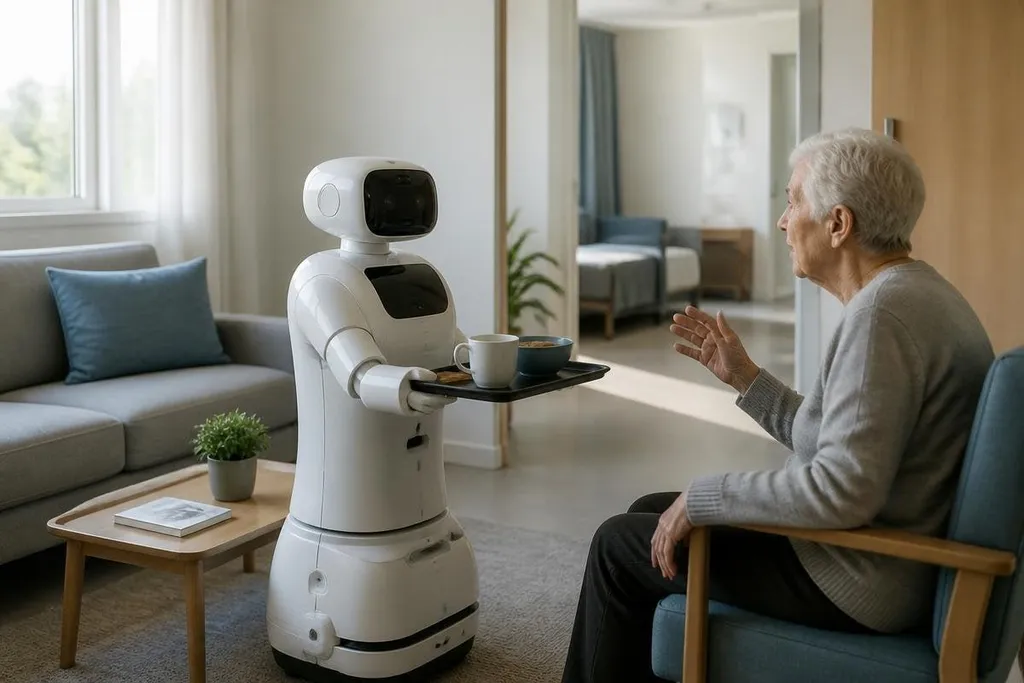
A robot can detect a raised voice, a pause, or a change in facial movement. It can then choose a different action, even though it has no inner feeling to guide that choice. For a person working with a service robot, the useful question is how well that process works in real settings.
Quick read
- Cameras, microphones, and touch sensors give robots clues about human mood.
- Software turns those clues into estimates, not facts.
- Good systems need clear limits, human control, and a way to correct mistakes.
What a robot can detect
A robot does not see sadness or stress directly. It measures signals that may appear alongside them, such as speech volume, speaking speed, facial movement, body position, or the force of a person’s touch.
The system combines those signals with the task and the setting. A loud voice in a noisy workshop may mean a person is trying to be heard. The same voice in a quiet care setting may point to anger, pain, or fear. The sound alone cannot settle the question.
Cameras can track posture and facial movement. Microphones can examine speech patterns. Touch sensors can detect pressure or sudden contact. A robot with access to several sensor types has more information to work with, but extra data does not remove uncertainty.
How the response is chosen
Software first turns sensor readings into an estimate, such as calm, confused, upset, or uncertain. A control system then links that estimate to an action. The action might be slowing speech, repeating an instruction, keeping more distance, or asking a person for help.
That last step matters because the robot should respond to the task, not perform a diagnosis. A warehouse robot could pause when a worker steps into its path. A care robot could ask the person to confirm discomfort. Neither system needs to claim it knows what the person feels.
The safest design keeps the response small and reversible. Lowering the robot’s speed or asking a question gives the person room to correct the machine. A robot that changes a medication plan or refuses service based on a mood estimate would need much stronger evidence and human oversight.
A mood estimate needs a named robot and a recorded response, with proof that the signal worked beyond a lab demo. Robot24.com robotics coverage can place that claim beside the sensor and test result, so you can see where a feeling estimate still falls short.
Why the estimate can fail
Human expression varies across people and places. Some people speak loudly by habit. Some avoid eye contact. A person with a speech, movement, or vision difference may produce signals that a model reads incorrectly.
The setting creates more problems. A worker wearing hearing protection may not respond to a spoken alert. Poor lighting can affect camera input. Background speech can confuse a microphone. A robot trained in one building may face different sounds, distances, and work habits in another.
Privacy also changes the design. A system that stores video or audio creates a record of people’s behavior. People need to know what the robot senses, how long the data stays, and who can access it. The machine should collect only what the task needs.
The hardest limit is hidden intent. A person can smile while feeling worried, stay quiet while feeling angry, or sound calm during pain. I’d trust a robot to notice a possible problem and ask what is wrong, not to declare what a person feels.
Practical checks before deployment
Use these checks before putting a system near customers, patients, or workers:
- Define the response: Write down the exact action tied to each signal.
- Keep people in control: Give a person a way to pause, correct, or override the robot.
- Test across users: Include different speech patterns, movement styles, lighting, and noise levels.
- Show uncertainty: Let the robot say it is unsure instead of forcing a mood label.
- Limit stored data: Set a clear rule for what gets recorded and when it is deleted.
- Review failures: Log mistaken responses and check them with the people affected.
These checks move the system toward practical assistance rather than mood scoring. They also give engineers a way to measure the cost of a wrong response, which may be a delay in a warehouse or a serious safety issue in care.
Robots can react to signs linked with human feelings, but the signs remain indirect. The useful system will ask, pause, or change its behavior at the right moment, then leave the person free to correct it.